Learning about Spatial Awareness with Boxes

Spatial Awareness with Boxes

Post by Contributing Writer Jennie

I don’t know about you, but I LOVE doing my Christmas shopping online!  When the packages arrive on my front porch I am not only excited for the contents inside, but I am just as excited for the boxes they came in!  Around our house, boxes equal hours of play time fun for all three kiddos!  They also provide an excellent activity to teach spatial awareness.

Here is what you’ll need: boxes of various sizes and a few toys

To get started, set the box on the floor with a few toys inside of it and invite your little one(s) to come and explore.


Gently set your baby inside of the box or let your bigger kids climb inside.


I started with a smaller box that Twin Girl and Twin Boy could see out of, and then I moved them to a bigger box that had taller “walls.”  This was a fun place for them to “hide” and play peek-a-boo.


I took this box and opened up both ends to make a tunnel that they could crawl through.


We also have a really big box that they could all walk or crawl inside of.


Our all time favorite box is one that their Daddy made into a “fort!”  He cut a little door out of it and some windows too.  They absolutely LOVE crawling in and out!


I laugh to myself when I see my kids try to squeeze through a tiny gap between our furniture and the wall because I know that there is no way they can do it; however, they do not know this yet.  They need those opportunities to understand how their body size and shape fits in a given area.  Using boxes to teach spatial awareness to young children allows them this key opportunity.


Jennie is a stay-at-home mom to a 3 year old boy and 1 year old boy/girl twins.  She received a degree in early childhood education and has several years of experience teaching both Pre-Kindergarten and Kindergarten prior to having children.  She realizes that as busy moms we need simple ideas that will make a BIG difference to our young children!

  • Share This Post:
  • Share This Post on Facebook
  • Share this Post on Twitter
  • Email this Post

Petite Picasso


Post by Contributing Writer Jennie

“Every child is an artist.  The problem is how to remain an artist once we grow up.”

-       Pablo Picasso

This quote from the famous artist is so true!  I remember as a young girl loving to draw.  I kept sketch books for several years; however as I reached my adolescence I slowly stopped.  Art class was not mandatory at school anymore and I didn’t have as much free time either.  The leisurely pace of childhood had passed.  I think the importance of this post is two-fold: to first, work on your little one’s fine motor skills by teaching them to scribble, and secondly, to instill a love for “art” at a young age!  Some children will be naturally drawn to art more than others and that’s okay.  Every child has different interests and abilities.  However, we as parents (and our children’s’ first teachers) can allow them essential time to slow down life and be creative!  Take a few minutes every day to scribble, paint, mold with dough, or any other activity that speaks to your child’s inner artist!

For this particular activity, here is what you’ll need: crayons and markers, a large piece of paper or a brown paper shopping bag, and an adult’s lap to sit on.

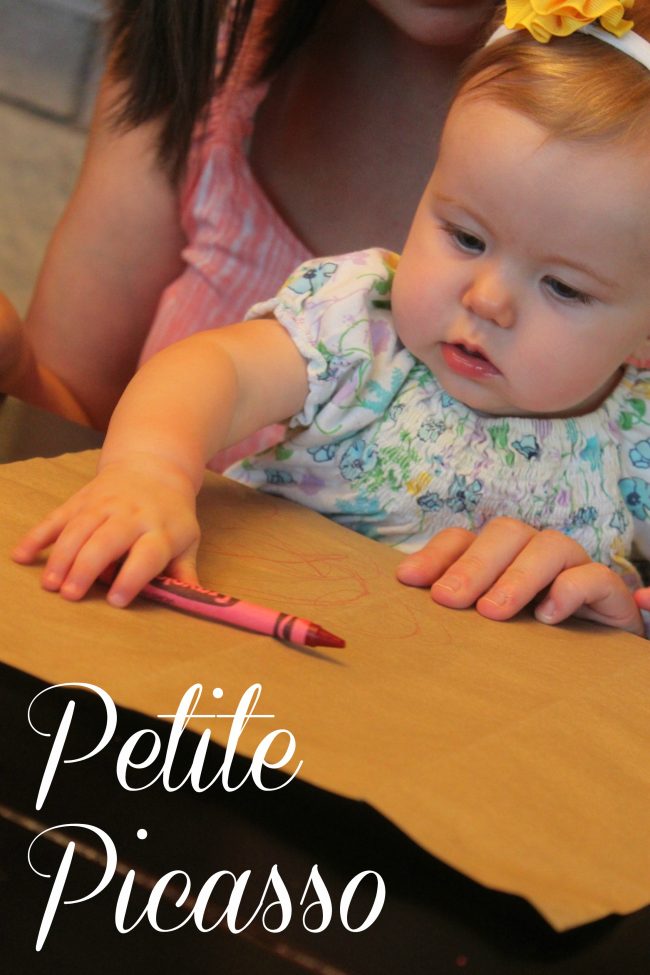
Begin by showing your baby the crayons and paper, and then demonstrate how to scribble on the paper.


I chose to use the side of a brown paper shopping bag because it is larger than a regular piece of copy paper.  Our large muscle groups (gross motor) develop before our small muscle groups (fine motor), so it is difficult for a baby to scribble on a small piece of paper.  I also chose to use crayons because the wax on the paper provides friction, which is stimulating to the nerves on the fingertips.  This tactile exercise sends a stronger message to the brain versus a writing utensil that doesn’t provide much friction, like a marker.

Now, let your little one have a turn.  He or she will likely draw in a circular motion as this is the easiest motion for a baby and even a young child to do.


I repeatedly had to remind Twin Girl that “We don’t eat crayons.”  (This is why I said you need an adult’s lap to sit on! J)

As your little one scribbles, talk to him or her about the picture: “What color did you use?  What shapes do you see?”

Now help him or her press down firmly and then press down gently.  Use those words to describe the different pressures.


Next, I offered Twin Girl a marker.  I chose to use a marker this time so she could see the fruits of her labor easier!  Like I wrote earlier, a baby’s fine motor skills develop slowly, so she does not have the strength she needs quite yet to “color up a storm”!  She can color with the marker much more effortlessly.


This first piece of art work may not be “fridge-worthy”, but you did provide a vital learning opportunity!


Jennie is a stay-at-home mom to an almost-3 year old boy and 9 month old boy/girl twins.  She received a degree in early childhood education and has several years of experience teaching both Pre-Kindergarten and Kindergarten prior to having children.  While she jokes that she’s had a successful day if “no one goes hungry or gets hurt”, she realizes that it’s the little things we do that we might not even know we’re doing that make a BIG difference to our children!

  • Share This Post:
  • Share This Post on Facebook
  • Share this Post on Twitter
  • Email this Post

My First Game of Hide-and-Seek

Post by Contributing Writer Jennie

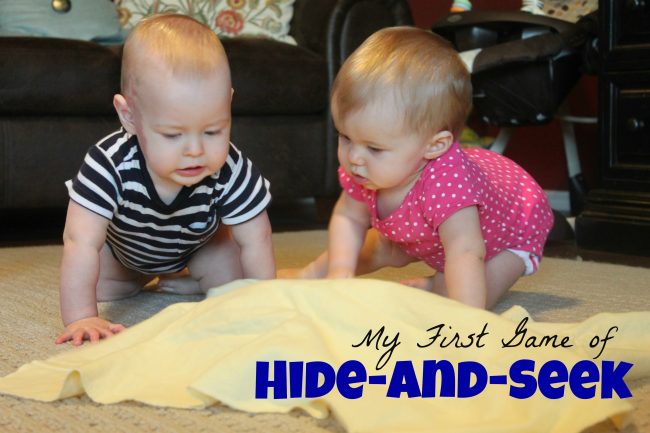
Every child loves the game of hide-and-seek.  This version is for your little ones who have reached the developmental milestone of understanding object permanence, which means that your baby knows that a person or object still exists even when it can’t be seen.  Typically this occurs around 8 months old, but remember every child develops differently!  I knew my twins had reached this step in cognitive development when they began throwing things from their highchairs and then looking for them!

Here is what you’ll need: a small toy (preferably one that makes a sound) and a small blanket to cover the toy

Begin by showing your baby the toy,

then cover it up with the blanket.  (You may want to leave a little bit of the toy showing the first time you play.)


“Where did it go?  Can you find it?”

Here is the advantage of using a toy that makes a sound: they can hear it, but they can’t see it!  This makes the game is even more intriguing!

Watch as your little one uses problem solving skills combined with his/her understanding of object permanence to find the toy!


Praise your little one on a job well done!


Jennie is a stay-at-home mom to an almost-3 year old boy and 9 month old boy/girl twins.  She received a degree in early childhood education and has several years of experience teaching both Pre-Kindergarten and Kindergarten prior to having children.  While she jokes that she’s had a successful day if “no one goes hungry or gets hurt”, she realizes that it’s the little things we do that we might not even know we’re doing that make a BIG difference to our children!

  • Share This Post:
  • Share This Post on Facebook
  • Share this Post on Twitter
  • Email this Post

Baby Bounce

Post by Contributing Writer Jennie

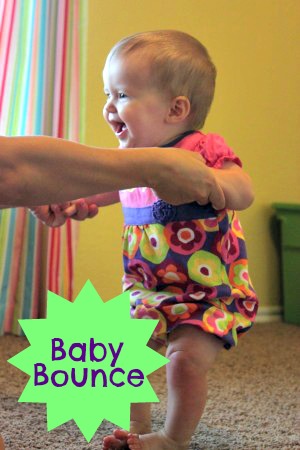
Everyone loves a happy, bouncy baby, right?!  If I could do as many “squats” (aka bounces) as my twins do in one day I would have some pretty awesome quads!  Seriously, have you ever tried to mimic your baby with all the movement he/she does?!  It’s exhausting for adults (or at least out of shape ones like me), but oh so important for your little one’s gross motor skills!

Start your baby in the seated position.

Hold onto your baby’s hands and gently pull them up to standing.


Encourage your baby to bounce up and down.


Twin Boy wanted to show off his skills too.

Now your turn!  ;)


Jennie is a stay-at-home mom to an almost-3 year old boy and 9 month old boy/girl twins.  She received a degree in early childhood education and has several years of experience teaching both Pre-Kindergarten and Kindergarten prior to having children.  While she jokes that she’s had a successful day if “no one goes hungry or gets hurt”, she realizes that it’s the little things we do that we might not even know we’re doing that make a BIG difference to our children! 

  • Share This Post:
  • Share This Post on Facebook
  • Share this Post on Twitter
  • Email this Post

Tug-a-Toy: Gross Motor Game for Babies

Contributing Post from Jennie

Picture yourself sitting peacefully on the couch playing sweetly with your baby, then – ouch! – those tiny fingers grab a big chunk of your hair and hold on for dear life! Sound familiar?  We all know how much babies LOVE to practice that strong grip, so let’s put it to the test.  Let’s play Tug-a-Toy!  Not only will this be fun for you and your baby, it will also be great gross motor practice for those arms!

Here’s what you’ll need: a soft toy that’s easy for your baby to grasp or a small piece of cloth (like a clean burp cloth) will work too.

Encourage your baby to hold the toy.

Then grab the other “end” and give it a little tug.

If your little one really enjoys the back-and-forth game then feel free to tug slightly harder each time, but try not to upset him/her.

Twin Boy decided he wanted a piece of the action.  One of the great things about having twins is they have a built in buddy to play with!

Now if you’re little one really loves to play hard, then you can try the next step: You can try to raise him/her off of the ground just a little bit!  My twins aren’t that brave!

What a good work out for those arms and shoulders!  Next thing you know they’ll be 3 years old and asking you to help them hang on to the monkey bars at the playground!


Jennie is a stay-at-home mom to an almost-3 year old boy and 9 month old boy/girl twins.  She received a degree in early childhood education and has several years of experience teaching both Pre-Kindergarten and Kindergarten prior to having children.  While she jokes that she’s had a successful day if “no one goes hungry or gets hurt”, she realizes that it’s the little things we do that we might not even know we’re doing that make a BIG difference to our children! 

  • Share This Post:
  • Share This Post on Facebook
  • Share this Post on Twitter
  • Email this Post