Counting Robots

Counting Robots


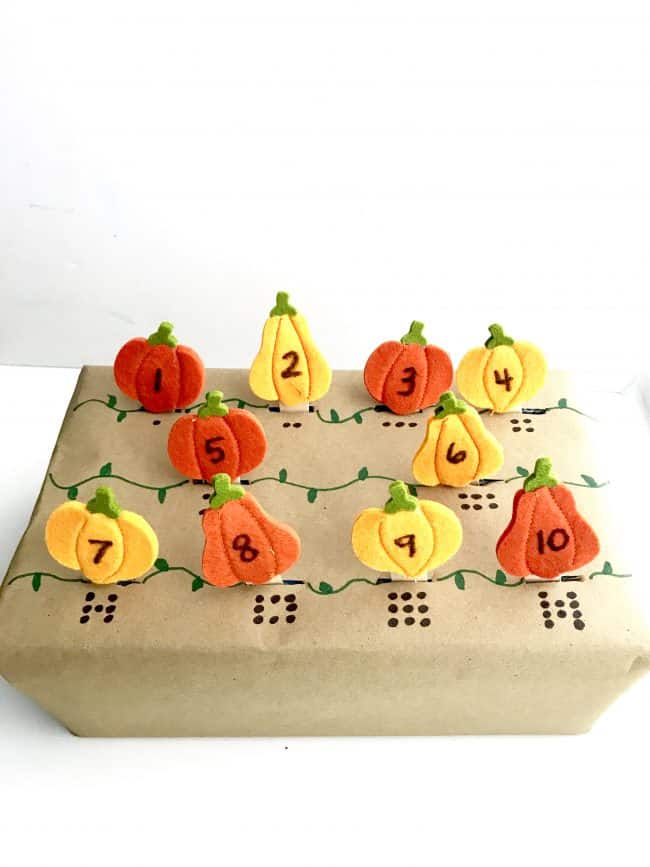
This simple activity is great for number recognition, one-to-one correspondence, and fine motor control!  We used some robot stickers to make the activity even more appealing to Little Brother.


Here’s what you’ll need:  craft sticks, clothespins,  robot stickers (which we received compliments of CraftProjectIdeas.com), and a Sharpie.

IMG_9928


IMG_9932 1.  Add your stickers onto each craft stick.


IMG_9933

 2.  Write the numerals on both sides of the clothespins.


IMG_9934


IMG_9939

3.  Give your child the craft sticks and have him/her count the stickers on each stick…


IMG_9944

…and then select the corresponding clothespin.


IMG_9945

Pinching the clothespin is great for developing the small muscles in the hands.


IMG_9948

 All done!


 Check out more number recognition activities here and on our Pinterest board!  


  • Share This Post:
  • Share This Post on Facebook
  • Share this Post on Twitter
  • Email this Post

“April Showers” One-to-One Correspondence Activity

April Showers One-to-One Correspondence Activity


One-to-one correspondence is a very important concept for young children and is a basic foundation for all of mathematics.  Simply put, one-to-one correspondence is the process of touching one object for each number that is counted aloud.  Little Brother sometimes still points to a group of 5 objects and counts the same object 2 or 3 times.   This isn’t uncommon for young children, but we thought we might do some “April Showers” one-to-one correspondence practice!


IMG_9533

Here’s what you’ll need:  construction paper (I used pink, blue, and brown), scissors, clear contact paper, and painter’s tape (or masking tape).


IMG_9534

 1.  Draw an umbrella shape on a piece of construction paper and cut out.


IMG_9540

2.  Hang a piece of contact paper, sticky-side-out, on a window and secure it in place with some painter’s tape (or masking tape).  You could also hang it on a wall, just make sure the tape you use won’t peel off your paint!


IMG_9545

3.  Cut out 15 small raindrops from the blue construction paper.  *Caution*:  If you are doing this activity with children younger than 3, make sure it is supervised at all times due to the small raindrops.


IMG_9555

4.  Write the numbers 1-5 on the umbrella and have your child place the corresponding number of raindrops underneath each number.


IMG_9558


IMG_9567


IMG_9568

 All done!


  • Share This Post:
  • Share This Post on Facebook
  • Share this Post on Twitter
  • Email this Post

Counting Up to Big Numbers with an Abacus

Counting Up to Big Numbers using an Abacus


Another way to use an abacus is skip counting to higher numbers (and teaching place value in the process).  If you don’t already have an abacus and don’t want to buy one, you can make your own!

Write a two-digit number on a dry erase board or even a piece of paper.

If your child is still learning to count, he/she can count by ones while moving each individual bead.

Once he/she has mastered counting by ones to at least fifty and has begun skip counting, encourage your child to count by tens first and then ones to make the number on the abacus.

IMG_9383


IMG_9386


Counting by tens to 40 and then ones to 7.


IMG_9384


IMG_9385

This boy loves to learn!

What other creative ways do you have to use an abacus?  


Please note:  The links in this post may be affiliate links.  Please read my full disclosure policy.

  • Share This Post:
  • Share This Post on Facebook
  • Share this Post on Twitter
  • Email this Post

Skip Counting with an Abacus

Skip Counting with an Abacus


Using an abacus is an excellent way to make skip counting tangible for young children.  If you’re not familiar with the term “skip counting”, it is just another way to say counting by 10′s, 5′s, 2′s, etc.  This is an important skill for primary-aged children because it helps them recognize patterns in numbers (even, odd) and will eventually help them learn to count coins with greater ease.  (FYI:  I would not attempt to teach a child to skip count until he/she has fully mastered counting by 1′s to at least 50.)

By adding the physical element of manipulating the abacus, children can comprehend the action of skip counting more accurately than teaching using only rote memorization.  Whenever we can include multiple learning styles, a child tends to retain that information much easier.

One of my favorite resources to use to teach skip counting, along with the abacus, is this Intelli-Tunes CD from Ron Brown.  There are so many great songs on this CD, but my favorite are “10′s Lift Off” (which you’ll hear in the background in the video below), “Let’s Count by Five”, and “We’re Counting by Two”.


We combined the abacus and the Intelli-Tunes CD to practice counting by tens in this video:


The other two songs (counting by 5′s and 2′s) are pretty fast, so we’ll have to do some practicing before we attempt either of those with the abacus.

IMG_9357


Don’t forget:  If you don’t have an abacus, learn how to make your own here!  


Please note:  The links in this may be affiliate links.  Please read my full disclosure policy.


  • Share This Post:
  • Share This Post on Facebook
  • Share this Post on Twitter
  • Email this Post

Make Your Own Abacus

Make Your Own Abacus


We stumbled upon an abacus at an antique store around Thanksgiving.  Big Brother insisted that he needed it.  When we reminded him that Christmas was coming up soon, he decided he would ask for the abacus.  It was pretty humorous to see the look on people’s faces when they asked him what he wanted for Christmas.  It varied between a look that said something like, “What kind of kid wants an abacus for Christmas?” (my child, thankyouverymuch) and “What in the world is an abacus?”    :)

Christmas rolled around and Big Brother received his abacus (from my parents), much to his utter delight.  He was so excited and enjoys playing with it during quiet time in his room.  It has also helped him with one-to-one correspondence.

I wanted to share a few abacus activities with you this week, but thought it might first be beneficial to show you how you can make your own in case you don’t already have one.  And if you’re looking to buy one instead of make one, this Melissa & Doug abacus looks super sturdy.  We don’t actually have this particular one (remember, our is an antique), but you can’t go wrong with Melissa & Doug.


IMG_8974


Here’s what you’ll need:  pipe cleaners, beads, and 2 dowel rods.  We received all of these items compliments of CraftProjectIdeas.com.  You’ll also need a hot glue gun (not pictured).


IMG_8976


1.  Create 10 piles of 10 beads each, according to color.


IMG_8979


2.  Lay out 10 pipe cleaners between the two dowel rods and mark.


IMG_8980


3.  Attach the pipecleaners by twisting the ends around the dowel rods.


IMG_8982


4.  Secure them in place with a little hot glue.


IMG_8984


5.  Recruit your child to add the beads onto each pipe cleaner.


IMG_8988


Bonus:  This is great fine motor practice!


IMG_8989


6.  Wrap the other ends of the pipecleaners around the second dowel rod.


IMG_8990


IMG_8992


7.  Secure with a little more hot glue.


IMG_8995


Ta-Da!  Your abacus is ready!

Stay tuned tomorrow and Thursday for some ideas for using your abacus with your child!  


*Please note:  The links in this post may be affiliate links.  Please read my full disclosure policy.


  • Share This Post:
  • Share This Post on Facebook
  • Share this Post on Twitter
  • Email this Post