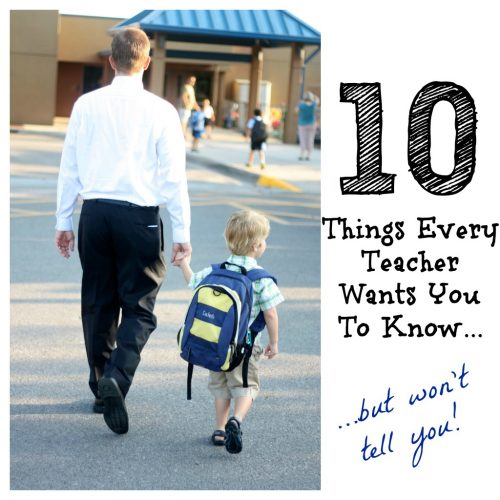
10 Things Every Teacher Wants You to Know…But Won’t Tell You


As a former first grade teacher and now a parent, I have seen both sides of the fence when it comes to schooling. I have said it a thousand times and I will say it again…I would be a much more understanding teacher had I been a parent first! There are SO MANY emotions that are involved when you hand your beloved child over to the care of a stranger and EVERYTHING said about your child (both positive and negative) is taken to heart.
Likewise, however, I think it’s important that parents recognize the growing demands of teachers and give them the respect that is due. Teaching is hard work…and it is getting only harder with all of the budget cuts and increasing class sizes. I’m playing “devil’s advocate” by sharing just a few things that I think parent’s should be aware of as well as sharing some suggestions from teachers who responded to this question on my Facebook page.
What Every Teacher Wants You to Know…But Won’t Tell You:
1. Your respect means the world to me. I truly care about your child and am trying to do my best to make sure that she is learning! Please show your child that you respect me by talking positively about me in front of her and backing me up when there are discipline issues at school.
2. We are a TEAM. We are both working towards the same goal when it comes to your child–helping him learn and be successful! If there is an issue and I share it with you, it does NOT mean that I don’t like your child…actually, it means that I care enough about your child to help him resolve any things prohibiting him or anyone else in my class from learning.
3. If your child is five years old or older, please make sure she knows how to tie her shoes…or buy Velcro shoes. Taking time to tie the shoes of multiple children in my class only takes away time that would otherwise be used for instruction.
4. Please don’t tell me your child is bored. I try to make learning as interesting and engaging as I can and telling me this makes it seem like you don’t think I am doing my job. Many times what might appear to be boredom is often a lack of self-control and/or self-regulation (which typically works itself out with maturity). If we need to work on teaching your child how to cope with down time, what to do if he finishes early, or how he can be challenged, let’s work together and come up with some solutions.
5. I put a lot of work into the parent newsletters that I send home. There is also lots of important information included, so please take just a few minutes to read it and check your child’s backpack every day.
6. Please bring individually wrapped or pre-cut birthday treats that are ready to serve. Trying to cut a cake while 26 (or more) hungry mouths are (not-so-patiently) waiting can often lead to complete chaos. And when you send a snack like applesauce or pudding, don’t forget the spoons!
7. Don’t assume that just because you struggled with a specific subject in school (i.e. math) that your child will as well. Always encourage your child in every subject, not just those that interest you.
8. Let your child make mistakes and try to do things by himself. Don’t rescue him whenever he can’t figure something out. It gives your child a feeling of power and control when he can handle things independently.
9. Make sure your child gets plenty of rest each night. Elementary-school children need at least 10 hours of sleep every night. Don’t overdo it when it comes to extracurricular activities–children need down time just like adults!
10. YOU are your child’s first (and most important) teacher. Trust your instincts. I have your child for 9 months and you have them for their entire lives–don’t underestimate your importance when it comes to your child’s education! Make your home a learning oasis and read to her every day!
You can read more responses from teachers here.



These are good. A whole-hearted amen to number 9! ( :
Number 6 made me cringe and smile at the same time as I remember parents sending cakes we had to cut in school and give out without making too much noise and mess…never a success, I must say :-)
Great list – I couldn’t agree more although I have to admit I did buy “C” tie shoes this year and she’s starting kindergarten and doesn’t know how to tie them yet — hope those double knots hold till she gets off the bus!
: ) MaryLea (pink and green mama)
I LOVE this post. Being a former first grade teacher myself and having a child getting ready to start kindergarten next year, I’m curious to see how my experience as a teacher will affect my opinions and attitude as a parent. Thanks for sharing!!
Tammy
1…2…3…Teach With Me
Dots of Fun!
Great list. I agree that had I been a parent first (before I taught) I would’ve been more understanding. That being said, one of the most important things I think you can do as a parent or a teacher is to be a good (positive) communicator. There are definitely things that parents (and teachers) should filter or say in a sensitive way, but I expect people to be honest with me. I think many, if not most of the things on this list, should be said at the beginning of the year. I think I have said almost all of these to parents at back to school night. It makes for such a better school year if you start it off by communicating your expectations clearly.
I love #7- not assuming your child will do poorly in the same areas of schools as you (including subjects, recess, and/or social issues like having bullies). I have a lot of anxiety attached to elementary school and I must remember that my daughters are different than I am. They may make friends easier, or do better in math, or even do worse in a subject than I did. It’s okay! We’re all unique.
It’s too bad that teachers don’t feel safe enough to mention this to their parents, especially in the public system. Both of my girlfriends teach K and I know that they do explicitly mention 2-6, 8-10 to their parents both individually and during K info nights. But not everyone teaches in a Christian school with Jesus-loving parents, and that makes all the difference.
I’m sorry but that sounds incredibly judgmental. You *seem* to be saying that only people who subscribe to your religious views can be…in this case not even moral but simply possessed of some good old-fashioned common sense. I think what you mean is that in some private schools there might be a different level of communication than in public schools, or maybe an understanding that folks are more or less on the same page in some ways. In public schools teachers *do* need to be aware of cultural, religious, and other differences, true. Those differences are what make our world rich. Learning to navigate them is a special gift not given to all. We have to start out with open minds. Peace and love to you.
Good to know that you think nothing of me as a parent because I’m an atheist!
I totally agree with all of these! Funny and very true!
This is a WONDERFUL list! I especially appreciated your comments as a former public school kindergarten teacher :) I also agree that my perspective totally changed when I became a mom, as I was far more understanding in hindsight of the parents I worked with. While I didn’t mind tying shoes (thought it did take time!), I did struggle to know that the attitudes of my students was so often shaped by negativity from their parents. Respecting teaching as a profession seems to be more of a struggle these days. I’d also add that parents should try and remember that their child’s teacher is a person as well, with a life and family outside of school, though so much of school overlaps into their world too!
Great post! Thanks Jenae! : )
All great points.
I remember snack time in the preschool classroom—one time we were trying to cut up one of those giant cookies into equally sized pieces. Not an easy task. lol
This is a great list! I’m a former 2nd grade teacher and now the parent of a Kindergartener, and I appreciate how hard the teacher’s are working for the well-being of my child! Pray for your child’s teacher every day!
This was VERY well said! I wish so much that every parent could/would read and understand your words. I am a retired teacher, having been in the classroom for 31 1/2 years, and I now work with student teachers and education majors at the university level. I miss my own classroom and teaching more than I thought possible, but one thing I do NOT miss are those parents who never seem to want to understand things from the teacher’s point of view. Through the years I worked with some fabulous, loving, caring parents who supported me whole heartedly, BUT….those who didn’t really made life and teaching so much more difficult. I loved every child I ever taught and only wanted the best for them. Thank you so much for putting into words what probably all teachers would like their parents to know. Hopefully many will read and comprehend what you are saying.
All of these are so true, and while there are items listed more important than newsletters, I like that comment the best. I have had 2 different students tell me their parents use my newsletter to put down where the dog goes to the bathroom! I think I’ll print this list off and have it at Open House.
Well written, indeed! I’m a teacher, too, and although I agree with all of your comments, saying your child is bored is something I never like hearing. We are doing our best to challenge all the students. And if you (the parent) believe your child is bored, let’s encourage them to read more – rather than demanding extra work from a teacher.
I tell parents to go home with the student and create an interest list to supply their own creative ways to combat what they see as boredom. It stops that line of talk and makes the child think for themselves!!
Great list – thank you for these tips!!
As an educator and parent, I totally agree with your list. Thank you for creating it!
This is exactly what I do tell my parents and most is outlined in my parent information that goes home
on oreintation night!!! If you don’t tell them they don’t know. They really do want to know your expectations.
Thanks.
Loved this list! With a fresh kindergartner this year, it’s great info to have.
I do have a question on #4. If a parent says the child is bored, couldn’t it simply be from an academic perspective, not a reflection on the teacher herself? Having homeschooled my daughter since birth, I know she is academically better suited for 2nd than for K. She thrives on challenge, and if she is bored, she is sloppy or refuses to work. I’ve been told the focus in K is to close the gap – intervene with those kids who are behind – which I can understand from an efficiency perspective, but what about what’s best for my kid?
How do I convey this without sounding derogatory or like a wise-ass parent? I’ve been told she will have an individual plan for reading/writing, so I’m comfortable with that, but what about the rest? She’s conceptually at a 4th grade level with math and has a wide scope of knowledge and vocab all across the board.
For now, I’m contenting myself with the knowledge that public school doesn’t END homeschooling – that will continue even though she is in school 30 hours a week…
I’m in the same boat. My son is gifted in math and an advanced reader. He loves science but our elementary school hasn’t really focused on science through second grade. I can’t really think of anything that he doesn’t get the first time you show him, which means he is bored quite a bit with all the repetition that goes on in the classroom. He doesn’t understand why he has to complete worksheet after worksheet with the same material when he clearly understands it. (I don’t necessarily think this a bad thing–we all have to do things we’d rather not–though it does seem a bit excessive to me.) I’ve spoken with his teachers and administrators about ways to challenge him and I get the same talking points about differentiated educational plans. That said, I do realize his teachers have twenty-five-plus kids of varying abilities. With that many children to teach, I don’t think it is humanly possible to reach every one of them, especially those at the high and low ends of the spectrum. His boredom is absolutely not a reflection of the teachers, though perhaps of the system, which seems to focus on meeting SOL requirements rather than true exploration and learning. It will be interesting when my daughter enters elementary. She is definitely an “inside-the-box” type of child, so I expect a completely different experience for her. The public school system’s one-size-fits-all approach just doesn’t–and I don’t blame the teachers or even the system, really. Ultimately, it’s up to the parents to find an approach that works for their children if the public school system doesn’t.
I am a teacher who cannot have children but has devoted 15 years of my life to educating children 0-12 years. Please show respect for teachers who do not yet have children or cannot have them. Parents often look down on those who are childess. I have some very interesting insights about children, i know them well. I do not have them 24-7 at home but i have ammased a lot of knowledge about children collectively. I can understand from what people tell me what it would be like to have to leave a child in the care of others, I can imagine it would be very daunting, but I also understand that I will not experience it as intensely as I would once I am in that position myself. I also regularly try to think about what it would be like to be a parent so that i canunderstand the parents i work with and that i have empathy and respect for them too. That being said though I put so much love effort and time into the children I have with me each year and I like to think that I have a partnership with the families that I deal with. I have been able to be a part of many children’s lives now over the years and still find it very rewarding work. I like to be trusted as a teacher, let parents know I am here to support their families in any way I can and give their children back to them at the end of the day feeling happy, healthy and enriched. There are still more things teachers want parents to know too….I am sure we could make another list of 10!
thank you for the list, helpful as a parent who’s son just started kindergarten!
To mary lea and others
Regarding tying shoes
I didnt learn this until I became a grandother
But when you reaad it you will say what I said…
Duha, of corse!
Before you tie your childs shoe, WET the shoestring
With water…then tie as usual.
As the shoestring dries, it will shrink
And become tight
Oh my goodness. What a fabulous tip. And you’re right — it’s one of those simple things but until you know it…it just doesn’t occur to most of us!
So many great reminders, Jenae!!
thank you for the list.
I have loved most of my kids teachers. But you make it sound like every teacher is a great teacher and I’m sorry to say there are some who shouldn’t be teaching or at least not in elementary school. The whole support me when I have disciplinary problems. My daughter was disciplined for things she didn’t do like for not handing in work that she had to miss recess for then the teacher later finding she (the teacher) had filed it in the wrong place. She got no apology for that. We tried working with this teacher with some other problems our daughter was having but every sensible suggestion was turned down. The teacher wouldn’t eben move her to a quieter table to try to cut down on the distractions caused by the students she was currently sitting g with. Or when my kindergartener messed in her pants because the recess teacher wouldn’t let her go to the bathroom. Its hard to have respect for teachers who pull stuff like that. Like I said I have loved most of my kids teachers but not all teachers are as great as this article makes them out to be.
This list is great. Thank you for sharing, as a parent and my children’s first teacher I appreciate the information, even though it is mostly common sense. The same thing goes the other way too, though. I try to supposed and respect my children’s teachers in all they do, I have been open and respectful in my communications.
I try really hard to help 3 children with homework at the same time. So far I think I have done a great job.
Teachers – I understand why certain rules and guidelines are set for SCHOOL and Classrooms. I don’t have to agree and I have a right to voice my concerns in a respectful way. With you also being respectful of me and my views. No, we will not always agree. That doesn’t mean we are wrong or right.
Let me be my child’s parent. I know my children just as much as you do. If not more. Please don’t tell me how to raise my children, and tell my children how awful parents are. We are working together to help our children to become the best they can be.
THEY are the main goal.
I think number 7 is huge. Parents often project difficulty onto their children by sharing their struggles and expecting nothing less. This can be an entirely limiting and a self-fulfilling prophecy when a child hear this! Each person is truly unique. Just because you struggled in math doesn’t mean your child will! After all a lot has changed since you were in school and they are a different person! Encouragement and parental involvement with the teacher can overcome obstacles if they arise! Until then we are best to encourage and keep our mouths shut about our obstacles! Hats off to the dedicated and talented teachers out there! You are a blessing!
“I would be a much more understanding teacher had I been a parent first!” <– this. I say it ALL. THE. TIME. It's such a different perspective now. Sadly, I don't want to return to the classroom, but I very often catch myself thinking about the changes I'd make now.
Nice tips! We have to help teachers help kids!