How To Read With Your Child
Guest Post by Leah of Your Dime Your Time
Reading daily with your child is critical to their development in many ways. There is no better way to increase vocabulary, teach literacy fundamentals, and expose your child to images and words to which they would otherwise not be exposed.
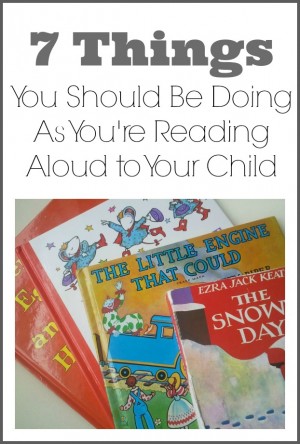
However, just saying the words on the page, while giving some benefits to your child, will not make the experience as productive as possible. By adding just a few small changes to your read-aloud time, you will be greatly increasing your child’s reading preparedness. Here are seven suggestions to make read-alouds the best learning experience possible every time you read together:
Read the Title, Author’s Name, and Illustrator’s Name-It’s important for children to become familiar with what these three things mean. Explain what author and illustrator mean. It’s also great for them to understand that every book is written and illustrated by real people.
Ask Your Child to Make Predictions-Read the title and look at the cover, then ask your child to tell you what they think might happen in the book. Most children will be quite uncomfortable with this in the beginning since they don’t know the answer, and they want to please you by saying only correct answers. Encourage them by saying that there is no wrong answer, but rather you just want them to take a guess. Ask them again in the middle of the book to make a prediction about how the story will end, and you could even make your own prediction and sometimes model that it’s okay to make an incorrect prediction.
Ask Your Child What Is Happening In the Pictures-It may not seem like pictures are as significant of a learning tool as the words, but when your child examines what is happening in a picture and explains it, it develops their inference skills. Just make sure not to do it with EVERY picture. Once or twice during a book will give them a chance to practice without completely interrupting the flow of the book.
Move Your Finger as You Read-By moving your finger underneath the words as you read, your child understands that you read left to right and top to bottom. It also helps children from a very young age to understand that the words you are saying are those written on the page, not just your own thoughts. However, this one takes a fine balance. Please don’t move your finger under every word on every page in every book. As a matter of fact, you should probably read most books without doing this at all. But every couple of days, use this trick on a page or two just so that your child will begin to take notice of some very important literacy fundamentals.
Ask Questions-Again, this involves a balancing act. Please don’t ask your child three questions per page. As a matter of fact, don’t even ask them one question per page. I think that asking a question every few pages is frequent enough to check your child’s understanding without breaking the flow of the story. You can ask basic recall questions, like “What did Mom say she needed at the store?” as well as reasoning questions like “How do you think Mom will get to the store?” and you can also throw in expansion questions like “What would you buy at the store to cook for dinner?”. The goal is to engage your child in the story, but beware that if you stop too often you will turn your child off to reading with you altogether because it will become a frustrating situation to them.
Reread the same books again…and again…(and again)-Most adults like to read a book once, and unless it’s a favorite, they will move on to another one. However, children like to read the same books over and over again. This helps them to make permanent in their mind the words and concepts that their brain is understanding. Regardless of the repetition, it is helping your child learn when you happily read and re-read books.
Really enjoy the book with your child-It really doesn’t matter if you follow each of these rules, AND establish a 1,000 book collection for your child, AND take them to the library twice a week. If you don’t take time to truly enjoy a book with your child, the likelihood of them enjoying it greatly decreases. Some of my children’s favorite books have been my favorite books, and I think it’s because my enthusiasm for the book shows. Enjoy the book and enjoy the time, because both are over much too soon.
Leah is a teacher-turned-stay-at-home-mom who loves to read with her children. She also shares tons of money-saving ideas, recipes, and family ideas atYourDimeYourTime.com.
If you are interested in learning about more tried-and-true strategies for teaching your child to read, check out my eBook I Can Teach My Child to Read.
More helpful reading resources:



Great tips! My son’s in Kindergarten (public school) and receives special reading help. One of the most important things they advocate for is pointing to the words as you read.
Thanks, I’m glad that you thought these tips were helpful. I’m happy to hear that your son’s school is sharing information with you as a parent. That’s so important and most definitely a sign of good things happening there! :)
loved this! as a children’s librarian, i praise everyone getting the info out there to make reading time exciting and playful to foster a love for books that will carry them through their lives.
I’m happy that you liked it, that means a lot coming from a librarian! I’m definitely in agreement with you that fostering a love for reading will help your child in more ways than we can probably even understand. Thanks for commenting!
Great tips! I wrote a blog about Picture Walking through books that would go hand in hand with this post!
http://ouroutofsynclife.blogspot.com/2012/02/how-to-picture-walk-through-book.html
What a great article, Heidi! I love that you point out that while to some it may SEEM like it’s a waste of time, it’s actually great in building the exact skills that you are striving for when reading with your child. And it really helped me understand the process of picture walking a bit better, and realize that it’s something I need to do more often with my kids! Thanks for sharing! :)
i can honestly say that my grandson and i truly enjoy our daily reading time together. However, sometimes he says, ‘can you just read the story without asking all the questions?!!!’ And it’s hard! Out of the mouths of babes . . . !
I had to laugh at this! My oldest child used to say the same thing to me. I was just so EXCITED to teach her everything that I couldn’t stop myself. ;) Since then I think I’ve found a better balance, but you’re right-it’s hard not to take that learning opportunity every time you see it! What a great grandma to take the time to read together!
Great reminders! Thanks for sharing!
I’m glad you liked it, thank YOU for reading! :)
My kids love having books read to them. It is a sad thing when a child doesn’t have someone to read to them. Excellent advice. I will work on these tips and see how it goes :)
http://www.callingallfashion.blogspot.com
I think that most kids who have had experience with being read to do enjoy it, and I agree-it’s sad to know that not all kiddos get that. What an amazing gift we can give to our children just by reading to them! :)
These are some great ideas and reminders! My daughter is almost 3 and she likes us to read the title of the books before we begin and the title page but I didn’t think about including the author/illustrator. I’ll start including that. And I definitely like the idea of asking her what she thinks might happen before we start reading or during. She probably won’t have an answer but it will encourage her to voice her thoughts and exercise her imagination. Another thing I do while I read with her is stop a few words before the end of the sentence to let her fill in the remaining words. She gets a big smile on her face that she knows the words too!
It’s fun to hear her “reading” her favorite books to herself, her stuffed animals or our cat. She misses a lot, but when she knows it, she knows it word for word!
I’m glad you liked some of the ideas! Predicting can definitely be hard for children at first, but once they get used to it, I am sometimes surprised at some of their great inferences based on only a book cover and title!
I love your idea of allowing HER to finish the sentences-what a great way to get her involved and make her start to feel like a real reader. Thanks for sharing!
Fantastic suggestions! I’m a reading specialist at an elementary school. Another fun way to enjoy books with your children is to make a photocopy of some of the characters and settings in the book (preferably on card stock). Let your child use to act out the story after you read it together. You can even staple the people to Popsicle sticks, to be used like puppets.
If the child is very young, and retelling the whole story is too much, then I like to copy just three scenes from the book and let the child put them in order: beginning, middle and end. Sequencing and retell are important skills that aid reading comprehension.
Thanks for the great post!
Whew~I’m glad I didn’t get a bad review from the reading specialist! LOL. I LOVE the idea of characters to act the story out. I can only imagine the extensions that could be used with those-what might happen after the story is over, what did they do before this story, etc…. I love it!
And I really like the sequencing with just 3 parts of the book, and then of course you could work up to more as they become better at it.
Thank you so much for sharing your fabulous ideas-I will be using these! :)
I also think it’s important for parents of young children to know that it’s okay to let kids ‘read’ a book by just memorizing it at the beginning. Eventually, we want them to connect the words on the page to the words they are saying, but at the beginning, just re-telling the story from memory and the pictures is still a good thing! (In part, because it’s just a child ENJOYING a book! You want to encourage that whenever possible, even if they don’t get every word right!)
Absolutely! I agree that sometimes as parents we want so badly for our child to “get it right” we can end up discouraging them from things that are actually very important beginning literacy practices. Great point!
I recently attended a seminar with Mem Fox – Australia’s most revered children’s book author and also the author of ‘Reading Magic’ and she espouses the theory that we should NEVER on the first read ask questions before, during or after. Totally immersing the child in the story is the most important thing you can do and they will be better equipped to make connections after that. Great advice for parents with young children.
Thank you so much for sharing that! I tend to remember this with new educational toys (allow them to simply play “their way” for some time before introducing a structured, educational way to use the toy) but I sometimes get so excited about new books that I delve right into asking questions and teaching, teaching, teaching. LOL. Thanks for a great reminder. :)
I’m a former kindergarten teacher turned SAHM turned blogger and I LOVE this post. I am a huge advocate for sharing easy, enjoyable tips parents can use to help their child learn to read and these seven ideas do just that.
My sons’ reading comprehension really gets a boost when I do picture walks with them before reading out loud.
Another trick I’ve found really helpful is teaching my boys to read the pictures of books rather than have them worry about the words on each page. My oldest now sees himself as a reader because he knows how to study the illustrations and gather clues about what is happening in the story. I share a step-by-step guide for teaching a child to read the pictures here: http://www.playdoughtoplato.com/2012/02/07/blue-group-reading-the-pictures/
Hope this tip helps too and thanks again for sharing.
I’m glad you enjoyed it! What a difference it makes when a child considers themself “a reader” from an early age. Thanks for sharing your link. I love that you point out “…several books only use pictures to tell a tale.” It is really amazing how much illustrations do for children. Thanks for sharing!
This was forwarded by my wife, Jordan Page (http://funcheaporfree.com), and I am reluctant to read all of the blogs she is into, but I took the time, and I don’t regret it at all. This was very well thought out, and makes a ton of sense. I think I know why I grew up hating reading, still do…but it was probably because of the way it was taught to me. I remember how frustrated I was as a kid!
I want to share this with my employees at http://launchleads.com just so they can share with their kids too.
Thanks for the help
Thank you so much for taking the time to comment! So glad you enjoyed it!
I’m so glad you enjoyed it, and I’m glad that it may help you and your employees foster a love of reading in your children! Reading definitely has the capability to frustrate a child, or it can greatly encourage and empower a child in their own learning. Thanks for sharing your thoughts and for passing the article along!
Great tips! We’ve practiced these and my 3 year old always asks “who wrote this book.” Another fun thing we do is let my 3 year old say part of, or finish sentences, (i.e. “George is a good little monkey and always….” Let him say “very curious.”)
Also, my son has memorized some of his favorites, like “Going on a Bear Hunt” and has great pride when he “reads” to company!
Thanks so much for sharing!
Awesome! Believe me, your child’s Kindergarten teacher will be very impressed that your child is curious about a book’s author.
Letting a child finish a sentence is a great practice for literacy as well as a great way to keep your chid involved in the book while reading! Thank you for reminding me of this fun practice. :)
We saw the importance of moving your finger under the words so clearly now that our 4 year old understands how reading multiple verses of hymns in church works! When I taught music in private schools, I struggled with teaching kids how to read all the top lines then all the second lines, etc. But last week my 4 year old gave me a tutorial in how to do it! The only thing my husband and I have ever done is to move our finger along as we sing in church.
This is a great article and very similar to one I recently wrote for my blog! Im adding you to my Blogs I Follow lit :-) I would love to have you read my blog! Onceuponastorybookblog.blogspot.com.
Found this on Pinterest and I would love to send it home with my students next week, but I’m having trouble getting to Leah’s website so that I can give her proper credit on anything that I send home. Any ideas on how to contact her or how to properly credit her?
Thanks!
Good tips! I also taught my daughter how to find the copyright and then we talk about how long ago the book was written.
As a 2nd grade teacher and new mom, I really appreciate this! I wish I could force every parent in my class to read it! I was reading the comments and someone mentioned how sad it is that some kids don’t have an adult who will read to them. It reminded me of my husband. He’s the middle child of five and spent a large part of his childhood with his grandparents. His grandfather read the paper and sports articles to him but not picture books. As someone who was read to a lot as a child, that made me so sad. Now when he’s sick I bring home some of my favorite picture books from school and read to him! Even adults love being read to. I know I do–I always stay with my class during library time so I get to listen to the librarian read to them!
I couldn’t help but cry when I read this my parents never read to us I was always behind in school and now that I have my own kids I’m doing everything I can to have them succeed. I love to read now ?
So glad you are making some important changes with your kids! Reading isn’t only great for their language development, it is also a special bonding time between parent and child! Way to go!
Hi,
Just found this page, and loved this post. Reading is huge in my house as well, and although my kiddo’s are getting older, 12 and 8, it was reassuring to me to know that doing all those things when they were little makes a difference. I still read to my daughter and occasionally read to my 12 year old. I would like to add that an additional resource is books on CD. After I read, or they read for their allotted time per night, while they are falling asleep they listen to a book on CD. My 8 year old gets hers from the kiddy section of the library and my son gets his from the YA section. He is particular about what he reads but loves these stories. Some of the kiddy ones come with the matching book. Great site, plan to look around more.
Very helpful tips! Thank you! :)
Love these ideas! As a teacher for over 30 years, and teacher young children who are blind or visually impaired, these are also excellent suggestions. These are great ways to learn the love of reading as well as the parts of a book and the left to right and up to down process of reading on a page. Those are good skills to learn whether visually impaired or not. I am remembering all these tips as I read to my first little grandson now! I have always loved reading and hope to help pass that along to him! And I think just hearing the voices of someone who loves you, reading to you, makes everything special!
These are all such wonderful ideas, Leah! I love the way you expand on each point. I will definitely be sharing this!
Great tips, I also like to ask questions like how many butterflies do you see? Where is the red car? What sound does the dog make? Can you show me something yellow? Etc..
Wonderful tips! It was reassuring to know that I’m doing the right things…and to know the why behind them too! Thanks for sharing.
Fantastic!
Beginning in the 1940’s, my father would read to us every night. In addition to the above suggestions, he would often help us find props and act out a story. It could be very simple–As three little pigs, we hid under newspapers and shouted, “Not by the hair of my chinny-chin-chin!” My father gave his three little girls the gift of the love of reading.
It means that you get total discounts at the time of subscription.
They offer so many extras that make starting up a new website so simple that even a complete novice could get a website up and running.
Elements such as text, graphics, images, font sizes and
colors are used in designing and producing pages for a
web site.
I’ve taught hundreds of kindergarten, first and second grade students to read over the past 31 years, and all I have to say about this article is, “Amen!”
I loved that you recommended having children talk about the pictures in the books they read, not just the words. My daughter is entering the 2nd grade next year and is excited to further her reading skills. Next time I am reading with her, I will make sure we don’t merely emphasize the words but enjoy the pictures, too.