I Can Teach My Child to Read eBook

I Can Teach My Child to Read eBook


I’ve been keeping a secret from you all for the last couple of months…I’ve been working tirelessly on a brand-new eBook titled I Can Teach My Child to Read:  A 10-Step Guide for Parents.  I am so excited to announce that it is available TODAY!!!  In honor of the eBook launch and because I am so thankful for each of you, I am offering this eBook at  half-off for just $1.99 (regularly $3.99) through Saturday, January 12th as a PDF or Kindle Version!


“Children are made readers on the laps of their parents.”  -Emilie Buchwald


If you have spent any time around here, you know that I am passionate about parents being their child’s first teacher (hence the name of the blog).  Whether your child will attend a public school, private school, or be home-schooled…you are and always will be the most important teacher in her life.   There is no better person to begin the lifelong process of teaching your child to read than you!


In this book I share the basic fundamentals of teaching a child to read in simple, easy-to-understand language that can be implemented the minute you set this book down.  After reading this book, I hope you will feel equipped and empowered to begin teaching your child to read!


I Can Teach My Child to Read eBook


What You Can Expect to Learn From This Book:

  • A balanced approach towards reading with comprehension and enjoyment as the ultimate goal.


  • The importance of reading aloud to your child even after she has become a proficient reader herself.


  • Tips for teaching your child to identify the letters of the alphabet within her environment.


  • Activities that promote literacy while incorporating multiple senses and areas of development.


  • Comprehension strategies that ensure your child is remembering and retaining what she has read.


  • Simple phonemic awareness activities that you can easily incorporate into your daily routine.


  • The necessity for teaching phonics and sight words.


  • Decoding strategies that will engage your child.


  • Tips on choosing “just right” books for your child to read independently.


Are you ready to dive in?  Great!

Grab the PDF version by clicking below.  This will allow you to download and print the eBook.

Add to Cart


Or get the Kindle version here:


If you read it and enjoy it, I would be so appreciative if you would leave a review on either Amazon or my comments page.


Also, if you are a teacher and would like to print a copy for each family in your class, you can buy the classroom version for $15.  It is identical to the original in every way, but the copyright allows you to print up to 25 copies.


Do you have a blog, a Facebook page, or perhaps even a few friends you think might benefit from reading this book?  Become an affiliate and receive a portion back from every sale!   


  • Share This Post:
  • Share This Post on Facebook
  • Share this Post on Twitter
  • Email this Post

Children’s Literature: Caldecott Winners from the Past 15 Years

After sharing my tips for choosing a good children’s book last week, I thought I would introduce you to the Caldecott Award.

If you’ve been around Children’s Literature at all, you’ve probably heard books referred to as “Caldecott Winners” or “Caldecott Honor Books”.  Here is what the Caldecott Award is all about:

“The Caldecott Medal was named in honor of nineteenth-century English illustrator Randolph Caldecott. It is awarded annually by the Association for Library Service to Children, a division of the American Library Association, to the artist of the most distinguished American picture book for children. ”  -ALSC website

Although a book is awarded this honor based on its illustrations, the Caldecott winners are normally well-written and extremely engaging for young children.

Here are the Caldecott Winners for the last 15 years.  Go here to find the complete list of Caldecott winners since 1938 (along with each year’s honor books).


2012

A Ball for Daisy by Chris Raschka

2011

A Sick Day for Amos McGee by Philip C. Stead

2010

The Lion and the Mouse by Jerry Pinkney

2009

The House in the Night by Susan Marie Swanson

2008

The Invention of Hugo Cabret by Brian Selznick

2007

Flotsam by David Wiesner

2006

The Hello, Goodbye Window by Norton Juster

2005

Kitten’s First Full Moon by Kevin Henkes

2004

The Man Who Walked Between the Towers by Mordicai Gerstein

2003

My Friend Rabbit by Eric Rohmann

2002

The Three Pigs by David Wiesner

2001

So You Want to Be President? by Judith St. George

2000

Joseph Had a Little Overcoat by Simms Taback

1999

Snowflake Bentley by Jacqueline Briggs Martin

1998

Rapunzel by Paul O. Zelinsky

1997

Golem by David Wisniewski

Have you read any of these books?  Which is your favorite?  

  • Share This Post:
  • Share This Post on Facebook
  • Share this Post on Twitter
  • Email this Post

Pound-a-Sound

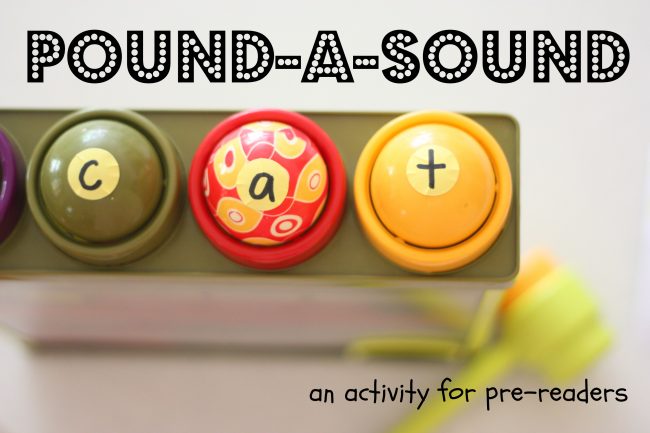
There are a few wonderful things about this activity.  First of all, it teaches left-to-right orientation, which is an important pre-reading skill.  Secondly, it is great for the relationship between a sound (phoneme) and its corresponding letter (grapheme).  Finally, it’s a wonderful way for kinesthetic learners to begin decoding (or sounding out) words.

Big Brother has known the majority of the letter sounds for several months, but he has just now started showing interest in starting to put those sounds together.  He started attempting this himself in books and on signs he sees, so I figured it wouldn’t hurt anything to start working with him a little here and there.  Let me clarify, however, by saying that we are not pressuring him to “read” as a 4-year old but we are piggy-backing on his natural curiosities!

I love to repurpose toys for educational games and this was certainly no exception!  There are two toys we used that essentially worked exactly the same way:  This Whacky Ball Maze and this Pound-a-Peg from Melissa & Doug.  In addition to one of these toys (or something similar), you’ll need some dot stickers (like what you use to price garage-sale merchandise) and a permanent marker.


1.  Write your letters on the dot stickers.  I chose to do a 3-letter consonant-vowel-consonant (CVC) word to make it simple.


2.  Place the letter stickers on the pounding toy.


3.  Show your child the left side of the toy and ask him/her to say each sound that the letter makes while he hits the ball.


This is Big Brother’s kind of learning!


“Can we do it again???”


Version #2 (with the Melissa and Doug Pound-a-Peg)

Attach the letter stickers to the toy.  Remove the remaining pegs to prevent confusing your child.


Let your child pound…


…and pound!


  • Share This Post:
  • Share This Post on Facebook
  • Share this Post on Twitter
  • Email this Post

Children’s Literature: How to Find a Good Book


We’ve all been there…we walk into the Children’s Section of a bookstore or library and are completely bombarded with thousands of books.  How in the world are we supposed to choose a good book for our children?  What defines a good book, anyway?

Here are just a few suggestions for ensuring that the books you spend your hard-earned money buying are worth the price (and the time it takes to read them).

Rule #1:  If it’s based upon an already popular movie character or toy, it’s probably not a high-quality piece of literature.

When I was teaching first grade, I had to put all of my “character” books (including Barbie, Nemo, Batman, etc.)  into a bin labeled “For Indoor Recess Only”.  The reason I did this is because if I left them with the rest of the books, the kids would choose these books first because they like these characters and are already fascinated with them.  The problem, however, is that these books are not typically written by authors aspiring to write a valuable piece of literature to be treasured by children and families for years to come.  No, usually these books are part of a marketing scheme adopted by big businesses to literally suck every penny they can out of a popular character.  More often than not, these books just plain stink when it comes to vocabulary, plot, character development and other important literary features.

With that being said, however, these books can sometimes be a great way to encourage a child who is initially uninterested in reading to finally pick up a book due to the fact that they are already interested in that particular character.  Having a few of these ‘character books’ around your house isn’t going to hurt anything.  Definitely encourage your child to branch out in his/her reading, however.  Keep in mind that any book is better than no book at all!


Rule #2:  Find a seasoned and successful author and expand your library to include more of his/her books.

If you’re not sure where to start, research a particular children’s author (who has written several books and is esteemed in the Children’s Literature community) and look for other books written by that author.  The reason for this is simple:  A successful author isn’t going to scathe his/her good name by writing an awful book.  This author has been around the block.  He/she knows what makes a good book (that’s why he/she is already successful) and won’t typically settle for less than his/her best.  Some of my personal favorite authors for early childhood are Eric Carle, Dr. Seuss, Jan Brett, Donald Crews, Kevin Henkes, and Mem Fox.

I feel it necessary to give just a humble word of warning when it comes to sequels.  In my opinion, it seems that sometimes an author can get carried away with the popularity of an excellent book and then try to duplicate it over and over and over again.  Case in point:  I discovered the first Fancy Nancy book in a book store back in 2006 when I was taking a children’s literature course (prior to having children of my own).  I absolutely loved the vocabulary as well as the story line and recommended it to several of my female students the following year.  I have read a few of the many sequels since then and haven’t been nearly as impressed with them.  I’m not bashing Fancy Nancy (or Curious George, for that matter).  However, it is a rarity when an author can continue writing in such a high-caliber fashion with the same characters and similar story lines.


Rule #3:  Explore the classics.

Ask any parent or grandparent what their favorite book was as a child and you will often find that book still gracing the shelves of most libraries or bookstores.  There is a reason for this:  The book is well-written, beloved by children and families alike, and has stood the test of time.

Here are just a few of my favorite classics:

Corduroy by Don Freeman
The Little Engine that Could by Watty Piper
We’re Going on a Bear Hunt by Michael Rosen
Where the Wild Things Are by Maurice Sendak
Harold and the Purple Crayon by Crockett Johnson
Cloudy with a Chance of Meatballs by Judi Barrett (Big Brother’s FAVORITE)
Caps for Sale by Esphyr Slobodkina
Fireflies! by Julie Brinckloe
The Very Hungry Caterpillar by Eric Carle
The Tale of Peter Rabbit by Beatrix Potter
Harry the Dirty Dog by Gene Zion

Librarians are an excellent resource for finding classic children’s picture books (or any book, for that matter).  Be sure to ask for his/her recommendation the next time you visit the library.  When in doubt, ask the librarian!


Rule #4:  Expose your child to various genres of children’s literature.

There are 5 main genres of children’s literature in preschool and early elementary that your child should be reading in my opinion:  Realistic Fiction, Fantasy, Alphabet Books, Song Books and Nonfiction.  Realistic Fiction are books that aren’t necessarily true but could actually happen in real life.  Fantasy books are those that can only happen in our imaginations and not in real life (talking animals, magic, etc).

Alphabet books are an excellent way to introduce children to letters of the alphabet as well as their sounds.  Nowadays, you can find an alphabet book for nearly every subject, including one for every state!  Song books are often repetitive, rhyming, and have a natural rhythm when reading them…which make them excellent read-alouds.  Children will often easily memorize the words to song books, which in turn builds their confidence in themselves as a reader.

Nonfiction books are those that tell actual facts about a topic or person.  We often wait until children are older to expose them to nonfiction texts, but I believe this is doing a huge disservice to our children.  Young children are naturally curious and find it fascinating to learn real facts about dinosaurs, dolphins, and volcanoes!  Harness that curiosity by reading an assortment of nonfiction books.  I personally really like the National Geographic Readers as a whole, but there are TONS of other great nonfiction books for every reading level.


Rule #4:  Use beginning readers and sight-word readers in moderation.  

When children are learning to read, they must be given opportunities to practice their decoding skills.  Beginning readers offer an opportunity for children to do just that.  We must use these readers in moderation, however, because the end goal of reading should always be comprehension.  Beginning readers are often extremely simple (rightly so) and have very little when it comes to plot, character development, etc.  For this reason, make sure that this is not the only reading material your child is engaged in.

I’ve said it a thousand times and I’ll say it again:  It does your child little good to know how to “read” if he/she can’t remember what was read!  While your child is learning to read, be sure to make time to continue to read to him!  Read for pure enjoyment some of the time and ask questions before, during, and after reading at other times.  Most of all, make reading fun and enjoyable for your child!

On a side note:  If you are interested in learning more about how to encourage reading comprehension, I would HIGHLY suggest Reading with Meaning by Debbie Miller.  It completely transformed how I taught reading in my first grade classroom.  This book is written for teachers in a classroom setting but can be easily adapted for parents as well!  


Looking for more tips on reading?  Be sure to read “10 Steps to Teaching Your Child to Read”.  


*The links in this post are my affiliate links.  Please read my full disclosure policy.

  • Share This Post:
  • Share This Post on Facebook
  • Share this Post on Twitter
  • Email this Post

Learning Sight Words


Guest Post by Julie of Make, Take, & Teach 


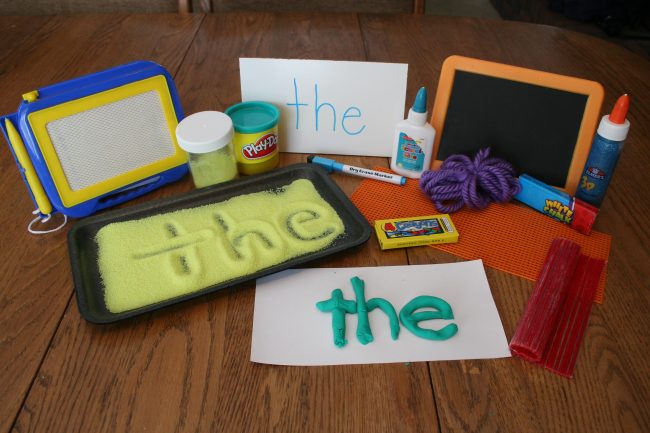
After your child learns the letters and sounds of the alphabet, the next step in learning to read is learning sight words.  Being able to recognize sight words is important because these words make up between 50-70% of the words we encounter in text.  Sight words are “service words” that must be quickly recognized in order to read fluently.  Many of these words cannot be “sounded out”.  Learning sight words can be fun!  We know children learn best when we use multi-sensory strategies.  This means that children are more likely to learn and remember when we provide opportunities to use as many of the senses as possible when we teach a skill.  Try using these multi-sensory activities to teach your child sight words.


  • Make a word with glitter glue.  Wait until the glue hardens, and have him/her trace the letters while saying the letter name and then the word (“t” “h” “e”- “the”).
  • Have your child use glue to make the word and then place yarn over the glue.
  • Use Playdoh to make a word.
  • Make a word with Wikki Stix.  Wikki Stix are wax covered sticks that can be easily bent into shapes.  Bendaroos also work great and can be found in most stores.
  • Have your child trace words in sand.  I use meat trays and craft sand.  Local butchers often are willing to give you a few meat trays for free.
  • Plastic canvas can be purchased at a craft store.  Have your child place paper over the canvas and write a word with a crayon.  When the canvas is taken away, the word is “bumpy”.
  • Of course, shaving cream is a popular multi-sensory activity!
  • Incorporating movement into learning sight words is also fun.  Try having your child jump, hop, clap or tap out the letters of a sight word.
  • When my daughter was little, we even made an old fashioned hopscotch game with chalk in the driveway and wrote our sight words in each box.


Here are multi-sensory cards for the first 25 Dolch sight words for you to use with the above activities.


Playing games with the sight words is also fun for children.  Try playing the Rats! game- children love it!  To make the game, simply print the activity single to double-sided. To play the game, scatter the cards word side down on the table.  Take turns turning over a card and reading the word.  When a player picks the Rats! card, all the cards are returned to the pile.  Play continues.


Julie is a Teacher Consultant and the owner of Make, Take & Teach.  Visit Julie’s blog at www.blog.maketaketeach.com or her website at www.maketaketeach.com for more free reading related activities and informational handouts.

  • Share This Post:
  • Share This Post on Facebook
  • Share this Post on Twitter
  • Email this Post